


By 2030, with domestic resources, Vietnam is committed to reducing its total greenhouse gas emissions by 9%. This number is expected to grow to 27% with bilateral and multilateral international support.
Accepting the invitation of US President Joe Biden, State President Nguyen Xuan Phuc attended the Summit on Climate. The conference was held online on April 22 and 23, 2021, with the main purpose of encouraging the international community to make stronger global commitments to responding to climate change in order to be able to achieve the goal of preventing the Earth temperature from increasing by more than 1.5°C compared with the pre-industrial era based on the spirit of the Paris Agreement on climate change.
Attending the opening session of this important meeting were the heads and prime ministers of 40 countries invited to the conference, including the largest economies and greenhouse gas emitters such as the United States, China, India, Russia, Japan, the countries making the strongest commitment to reducing greenhouse gas emissions, being the most vulnerable to climate change, or playing important roles in the regions of green economic development, together with the United Nations Secretary António Guterres and heads of many other regional and international organizations.
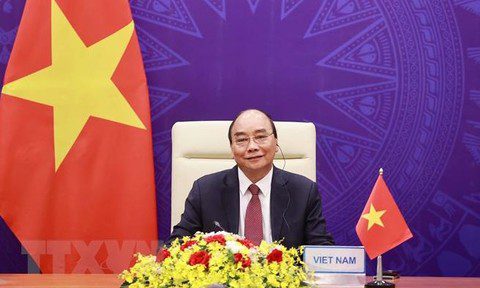
In the framework of the Conference, President Nguyen Xuan Phuc spoke at an important session on the topic “Economic benefits of Climate Action”. EHCMC would like to introduce the full speech of the State President Nguyen Xuan Phuc.
“Dear Mr. President Joe Biden,
Dear Presidents, Prime Ministers,
Ladies and Gentlemen,
Thank you President Biden for inviting Leaders of Nations and me to participate in this very important Conference. I highly appreciate the United States’ return to the Paris Agreement on Climate Change and believe that as a leader, the strong commitment President Biden made at the Opening Session, together with the cooperation of us all will turn the COP-21 Paris Agreement goals into reality soon. President Nguyen Xuan Phuc live from Hanoi.
Dear Mr. President and Gentlemen,
Currently, climate change is a huge challenge to the survival of many countries and globally. In 2020, Vietnam had to witness severe weather taking hundreds of lives and wiped out the long-term achievements in poverty reduction of many regions. The Mekong Delta, a large granary of rice and agricultural products, home to 20 million people, is being heavily damaged by sea level rise, especially at the end of this century.
Dear Mr. President and Gentlemen,
The transition to a zero-emission green economy is an inevitable trend and an urgent imperative to maintain the global temperature increase at 1.5oC. Challenging as it might seem, this transition brings great opportunities and benefits in terms of creating new jobs, ensuring energy security and enhancing the competitiveness and sustainability of the economy following this trend. At the same time, we need to have a suitable roadmap for developing countries.
I would like to emphasize a number of points:
First, the transition must be fair and inclusive, equal in terms of opportunities and benefits for everyone, take people as the center so that no one is “left behind”, and get supported by people, businesses and scientists.
Second, along with taking the lead in strong commitments to reduce emissions, developed countries need to increase practical assistance to developing countries, including Vietnam, in terms of finance, new technology and green energy development, efficient and high-quality infrastructure construction that help to create more jobs. We highly appreciate and look forward to receiving support from not only the U.S. International Climate Finance Plan, but also other international financial mechanisms, even international corporations
Third, the realization of the goals on climate should be appropriate to each country’s conditions, including changing lifestyles, ways of production and working, and should be integrated into the national development strategies and plans. Each country must first endeavor and use effectively the international support. At the same time, there should be a national mechanism for monitoring and evaluating performance and improving resilience.
Vietnam is a developing country that has only begun to industrialize in the past three decades, but always strives to contribute to global action. We soon sent the United Nations the Nationally Determined Contribution (NDC) and put the NDC into law enforcement for serious implementation. By 2030, with the domestic resources, we are committed to reducing the total greenhouse gas emissions from 9%, while with the international support bilaterally and multilaterally, the number can rise up to to 27%.
Vietnam will continue to drastically reduce coal power; to rapidly increase the rate of renewable energy to 20% of the total primary supply by 2030 and reach 30% by 2045. The amount of emissions per total GDP by 2030 is expected to decrease by nearly 15% with methane emissions in agricultural production dropping by 10%. Since the beginning of April 2021, Vietnam has launched a program on planting one billion trees by 2025, which is going to absorb 2-3% of emission amount by 2030.
Dear Mr. President and Gentlemen,
I am optimistic that the “challenges” of climate change will be the “driving force” for solidarity and positive change towards COP-26 in the UK, helping to create a sustainable future for generations to come.
Thank you very much.”
Source: Congan.com.vn


