


Each product must go through a lot of processes before being used. Understanding the structure and operating principles of solar energy will bring us a lot of benefits during installation and usage.
First, we need to know what solar power is. Solar power is the energy that is transformed from the sun through solar panels. Based on the photoelectric effect of semiconductors inside the panels, solar energy is converted into electricity provided for human daily life and production.
1/ The structure of solar power consists of:

* Solar panel system (Photoelectric cells)
The cells collect and convert solar energy into electricity, which is then provided for the whole system to operate.
* Solar charging system
The charging system ensures the charging of energy from solar cells to the battery system, so that the battery is not overcharged, nor discharged too much to maintain the device’s longevity.
* Inverter converting the power source:
The inverter converts the DC power source of solar cells into AC 220V
* Storage battery system:
The batteries are used to store power sources, then provide electricity for electrical loads when the grids are lost or the solar power systems do not produce electricity.
2/ Working principle of solar power:
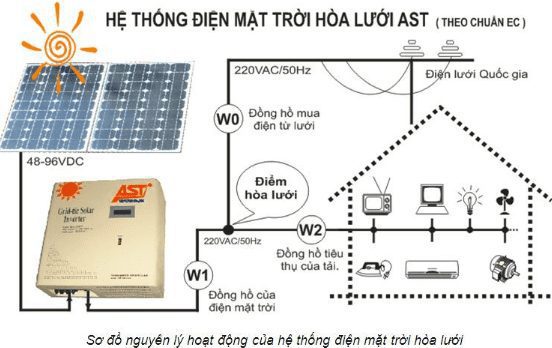
In general, the working principle of the system is quite simple.
First, solar panels are installed onto the roofs, walls or other favorable places to catch the sun. Direct sunlight onto the panels will be converted into DC as a result of photoelectric effect.
The DC continues to be transformed by the inverter and forms a 220V AC pure sine wave inverter with the same power and frequency as the grid. Through charging, the battery storage system will be fully charged with solar power, which is then directly connected to the national grid. Both power sources will provide power parallel for electrical loads, but solar power will be preferred. Unless the solar power does not produce enough to supply the system, the loads will receive electricity from the national grid.


