


Recently, the Vietnam Association of Port – Waterway – Offshore Engineering (VAPO) supported and participated in an Online Dialogue organized by the Department of Electricity and Renewable Energy and the Embassy of the Kingdom of the Netherlands on the topic: “Requirements for seaports and infrastructure for offshore wind power development in Vietnam”.
The dialogue attracted the participation of more than 200 delegates representing State management agencies, international organizations, financial institutions, enterprises, domestic and foreign consulting organizations and had important presentations and explanations to develop the infrastructure and seaport system for offshore wind farm projects.
According to experts from Vietnam Initiative for Energy Transition (VIET), to be able to establish a domestic supply chain for wind farm projects, a specialized port infrastructure is indispensable. In particular, the energy port for offshore wind power development needs to be designed to be capable of meeting the usage requirements for the installation phase of wind farms and providing operation and maintenance services.
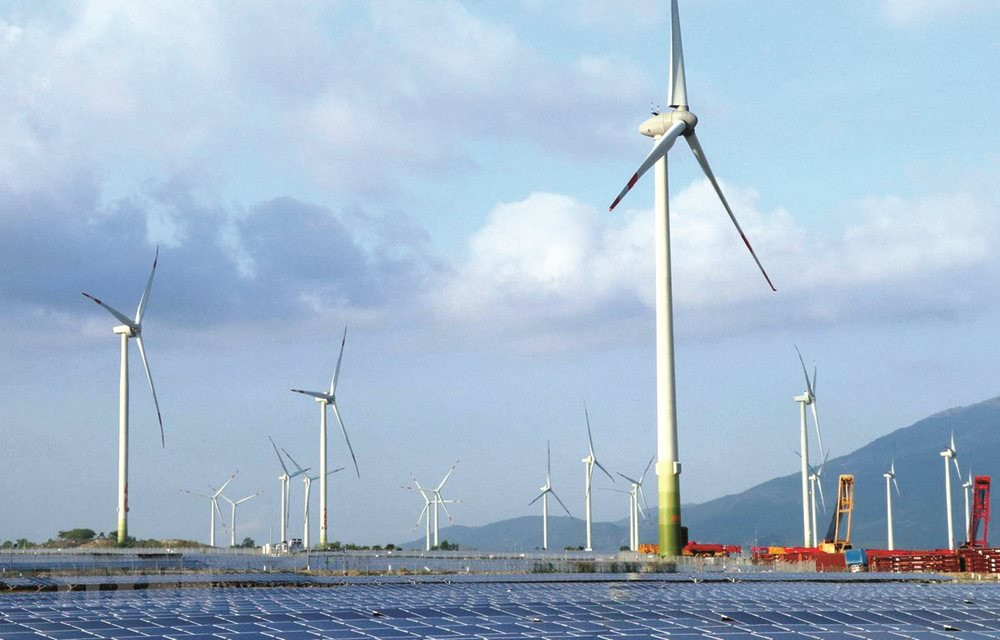
The infrastructure for offshore wind power development has relatively different characteristics. Ports serving this field are divided into two types: those for the installation phase and those for later operation and maintenance. Even the turbine sizes and foundations for large offshore wind farms require port system with stricter technical criteria.
Currently, Vietnam has 7 suitable seaport systems, which need further upgrading, to meet the technical requirements and planning for using offshore wind power development such as: Port of Hyundai shipyard, Vinashin (Van Phong Bay), Vietsovpetro Port (Vung Tau), Tan Cang – Cat Lai Port (Ho Chi Minh City), Tien Sa Port (Da Nang City), PTSC Downstream Port (Vung Tau), Tan Cang – Cai Mep (Ba Ria). These ports need to upgrade the force bearing capacity of the port area, the warehouse area, or the depth and width of the port area.
Assessing the seaport system serving the offshore wind power industry, Ms. Ngo Thi To Nhien, Executive Director of VIET said: “According to our research and analyses, the infrastructure for Vietnam’s energy sector is currently still weak, requiring a lot of resources and policies to develop.”
For now, Vietnam has about 5 power plant projects using LNG, concentrated in the Southern region and the Mekong Delta. Each of the power plants requires an import port to supply fuel. With a large demand for LNG in the future, we urgently need a central unit for importing as well as investing in infrastructure for this fuel. This unit will first help us take the initiative in balancing the input prices with the electricity prices. Having representatives to negotiate and buy LNG will be more beneficial than letting each project “self-handle” the input fuel supply. This unit needs to have the ability and experience related to gas trading and transportation, and ensure absolute safety for this very sensitive item.
Regarding seaports, the current works are not optimal for the development of offshore wind power, which is a very open field in the future. The upgrading of seaport infrastructure needs a lot of resources, so it is necessary to have a clear direction or policy to focus on development. For example, we may have a procedural or financial mechanism to orient a number of specific ports in each region to upgrade and renovate so that they can undertake the construction and installation of wind farms. Some smaller ports have been upgraded to deploy infrastructure for the maintenance of those wind farms.
Power planning VIII or the further goal is to ensure national energy security, it is necessary to have an exchange among ministries and sectors to better clarify how to implement, and a strong coordination to mobilize resources that are very scattered now.
“Transforming the energy structure in the coming period, towards prioritizing the use of renewable energy sources in the future, will help Vietnam promote multi-faceted socio-economic benefits while mitigating the impact of Climate Change”. The target for offshore wind power development by 2030 is from 3,000 to 5,000 MW, and approximately 21,000 MW in 2045 based on the Draft Power Plan VIII. Offshore wind power in particular is one of the world’s leading energy industries with important advances in technology, supply chain efficiency and service infrastructure.”
Mr. Pham Nguyen Hung – Representative of Electricity and Renewable Energy Department
Source: baotainguyenmoitruong.vn


