


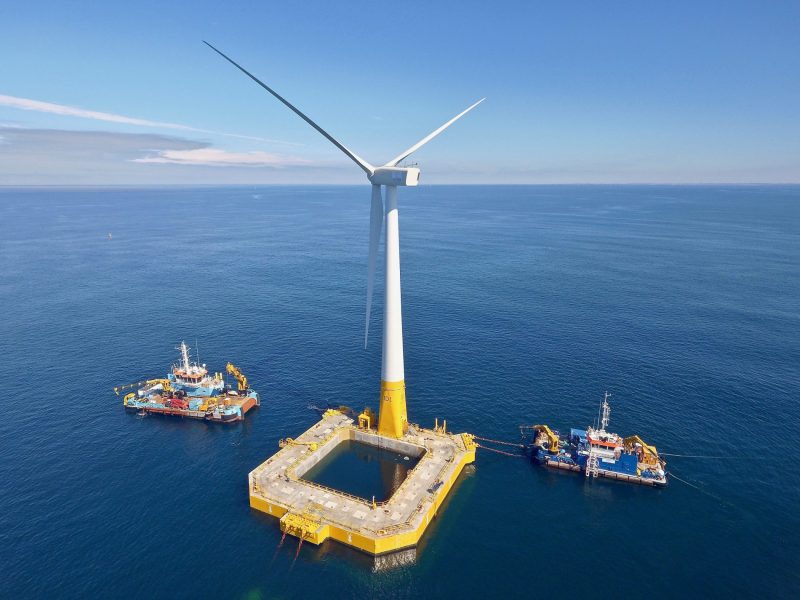
Many investors appreciate the huge benefits when deploying offshore wind farm projects in Vietnam. However, there are countless obstacles such as dozens of projects behind schedule, waiting for FIT prices, and racing to be sold at high prices before COD.
Three years have passed since the Prime Minister’s Decision 39 dated September 10, 2018 on the issued wind power prices, which was more than 2223 VND/kWh (equivalent to 9.8 cents/kWh), no offshore wind power project has started yet. Lots of investors, including foreigners, have conducted surveys and research on offshore wind power, and considered 2,200 VND/kWh to be “acceptable”. However, 3 years is still a short time for these projects to be implemented in reality.

In just over 2 months, the FIT prices are coming to an end. Many offshore wind power investors are holding their breath waiting for the next move from the Ministry of Industry and Trade and the Government. Will offshore wind farm projects continue to benefit from FIT prices (incentive power prices), or get bid immediately as planned?
On behalf of the investors, Ms. Liming Qiao, Asia Regional Director of the Global Wind Energy Council (GWEC), hoped the Ministry of Industry and Trade and the Government to apply FIT prices for offshore wind farm projects with capacities ranging from 4,000-5,000 MW, instead of only 2,000-3,000 MW by 2030 according to the draft power planning 8. GWEC research shows that whether to apply FIT prices or to bid right away is the choice of each country. In Taiwan, the Netherlands also applied bidding after the FIT price period for offshore wind power. Meanwhile, the French market, which is still new in offshore wind power development, has adopted competitive bidding from the beginning.
In Vietnam, the FIT pricing mechanism is also applied to offshore wind project, but in fact, 3 years is not enough for a project. Because, according to experts, if an offshore wind farm project wants to be economical, the scale must be 400-500 MW/project, with an investment capital of 800 million – 1 billion USD or more. Implementation time takes about 5-7 years, from the beginning of development to operation. These foreign investors are worried that if they proceed with the bidding right away, Vietnam might face the obstacles France used to experience. Offshore wind power is a very new field in Vietnam, and the domestic supply chain is also extremely limited.
Unforeseeable challenges
At this time, whether to apply FIT prices or to bid is still unclear. A “clear policy” is what many investors are “waiting”. Mainstream representatives said they are ready to start phase 1 of Phu Cuong (Soc Trang) 1,400MW wind farm project when there is a clear policy from the Government.
Investors believe that, after the end of the FIT pricing mechanism in November, Vietnam needs a new kick-off mechanism. Vietnam should continue to apply FIT prices for the first 4-5 GW, ensuring the stability of the market during the transition to the bidding mechanism. Because the first projects are very risky, they need to be supported with policies.

However, whether it is bidding or FIT pricing, offshore wind power will have to face many challenges. In particular, capital mobilization is a problem because these projects need large investment funds. Therefore, to approach international capital is very important, the policies need to be clear, stable and predictable. Additionally, will foreign investors accept to cut down on power output when there is a local oversupply of electricity at some points the same as it is happening with onshore solar farm or wind farm projects?
When foreign investors are asked about this issue, almost all of them expressed apprehension. An investor shared: Cutting output will be difficult for investors to raise capital, because it creates an unpredictable factor in terms of revenue. Most offshore wind farms need capital investment, so it must go through rigorous appraisal procedures of banks and insurance companies before a contract is signed.
Mr. Bernard Casey, Development Director of Mainstream Vietnam, admitted that capacity reduction is a huge risk. During the development phase, financial agencies will send experts to appraise projects, evaluate risks, and predict cash flows. If the project is too risky, it will not be possible to raise capital from the financial agencies.
This investor also said that capacity reduction can only be accepted in a short period of time and with a clear commitment.
“Đôi khi, nhà đầu tư có thể tính toán và chấp nhận chuyện cắt giảm công suất trong thời gian nâng cấp hệ thống truyền tải. Nhưng họ cần cơ sở xác đáng để chấp nhận việc đó chứ không thể nâng cấp liên tục rồi cắt gì thì cắt vì không thể dự báo được tài chính của dự án. Rủi ro này nhà đầu tư phải chịu, cho nên nhà đầu tư sẽ phải cân nhắc rất kỹ nếu như có chuyện cắt giảm công suất như thế”, ông Bernard Casey chia sẻ.
Ông Sean Huang, Giám đốc Phát triển Copenhagen Offshore Partner (COP), đơn vị đang tham gia dự án điện gió ngoài khơi La Gàn, bày tỏ: Khi ký hợp đồng mua bán điện (PPA), đã phải định được luôn cắt giảm công suất bao nhiêu, bao gồm cả lượng cắt giảm dự tính cho trường hợp bất khả kháng. Nhưng tỷ lệ cắt giảm này thường là nhỏ. Nếu việc cắt giảm công suất không nhỏ, cần tính đến các biện pháp khác để bảo vệ nhà đầu tư, như bồi thường. Ở Đài Loan, nếu cắt giảm nhiều họ sẽ kéo dài thời hạn của PPA ra để bù cho thời gian bị cắt giảm.
Mr. Sean Huang, Development Director of Copenhagen Offshore Partner (COP), a partner of an offshore wind farm project in La Gan, said: In a power purchase agreement (PPA), the amounts of capacity reduction must be determined, even the reduced amounts in force majeure. The rates of reduction are usually small; otherwise, different measures to protect investors should be taken into account, such as compensation. In Taiwan, if capacity amounts are greatly reduced, the terms of the PPA will be extended to make up for the reduction time.
Source: LB-vietnamnet.vn


