


The shift from fossil fuels (coal, oil and gas) to renewable energy sources (wind, solar…) is a common trend of the world and Vietnam cannot stand aside. However, the transformation roadmap, what mechanism is needed to ensure sustainability, equality, and harmonization of interests between the parties need to be studied carefully and cannot be rushed…
The above contents have been discussed quite carefully by managers and experts at the forum “Vietnam’s energy transition towards sustainable development” organized by the Department of Petroleum and Coal (Ministry of Industry and Trade) in collaboration with the Association of Vietnam Clean Energy Association that has been recently organized.
The boom of renewable energy
One of the important highlights of the energy transition is renewable energy (wind, solar…). Therefore, the Party and Government have many attractive mechanisms and policies to develop this “given” energy source. Thanks to that, in the past years, especially in the two years 2019 and 2020, renewable energy has “boomed”.
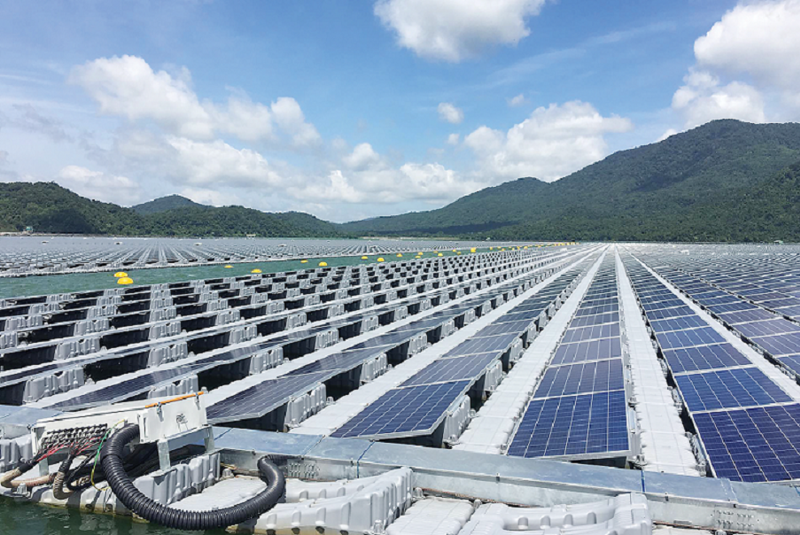
According to data from the Department of Electricity and Renewable Energy (Ministry of Industry and Trade), as of December 31, 2020, out of a total of 69,340 MW of installed electricity capacity nationwide, solar power accounted for 16,420 MW (including 8,673 MW of concentrated solar power and 7,755 MW of rooftop solar power); 514 MW of wind power; 382.1 MW of biomass power; 9.43 MW of electricity from waste. The total installed capacity of renewable energy accounts for more than 25% of the total installed capacity of the whole system.

Actual results in 2019 and 2020, the power output generated from renewable energy sources reached 5.242 billion kWh and 10,994 billion kWh respectively, contributing to a significant reduction in high-priced diesel electricity.
If comparing the actual mobilized oil power data with the Electricity of Vietnam (EVN) forecast, diesel electricity has decreased by 2.17 billion kWh in 2019 (equivalent to saving about 10,850 billion VND) and reduce by 4.2 billion kWh in 2020 (equivalent to about 21,000 billion VND).
Renewable energy sources have actively supported the supply of electricity to the North when there was a shortage of power in the North and high loads (for example from May to June 2021), contributing to ensuring power supply for the whole period 2021-2025, reducing greenhouse gas emissions and other polluting emissions such as SOx, NOx, dust, heat.
Nguyen Thi Khanh – Executive Director of the Green Innovation Development Center (GreenID), said that in the past two years, Vietnam has had a breakthrough development from a country with no achievements in the development of renewable energy to become one of the top 10 countries with the fastest growth rate, with the largest number of solar power capacity.
According to research data from 139 countries around the world, shifting and developing more renewable energy sources brings great benefits in terms of jobs.
“PDP 8 should still be persistent and continue with the goal of creating maximum opportunities and fully exploiting renewable energy sources in the country. Because these are forms of energy that are not dependent on coal, gas, and market price fluctuations. From there, there are policies, and markets to remove and promote the development of these energy sources, “said Ms. Khanh.
Moreover, Ms. Vu Chi Mai – Project Component Leader 4E – EVEF, GIZ Energy Program, said that energy transition does not have to eliminate what is already there, but a gradual transition from the exhaustible basic energy state to a cleaner form of energy, at a larger rate to ensure sufficient electricity and the requirements of climate change.
The experience of the previous countries shows that the sooner the energy transition happens, the greater benefits it will bring to the country, because it does not have to correct the mistakes of the past and have long-term policy to ensure more sustainability.
Careful calculation in the development roadmap
However, Mr. Pham Nguyen Hung – Deputy Director of the Department of Electricity and Renewable Energy (Ministry of Industry and Trade), said that the “hot” development of renewable energy also brings significant consequences for operation safety, power system security, increased transmission of 500 kV grid, impacting capacity mobilization and the number of times of capacity increase/decrease of thermal power plants and gas turbines.
In addition, increasing the cost and cost of the electricity industry, especially in the current condition that some types of renewable energy are still much more expensive than the average cost of the electricity industry.
According to Mr. Ha Dang Son – Director of the Center for Energy Research and Green Growth, we should look at energy transition first from the aspect of energy security.
The transition needs attention in four areas: Availability of energy sources; accessibility to energy sources in regions; people’s ability to pay and the acceptance of all kinds of energy in localities, where people are heading to…
Regarding the energy transition from using primary energies (coal, oil) to cleaner forms of energy, Vietnam must study in its roadmap, how to change, how to convert, the rate of sources in each period? Or do we just blindly follow Net zero (zero emissions) without having to be consciously consider the scientific studies?
“Currently, the trend of the world is to increase the share of renewable energy, and it can be said that wind, solar, and hydrogen will be the energy sources in the future. But like it or not, coal power will still play an important role in the background, and the world will not be able to completely eliminate coal power overnight,” said Mr. Son.
Having the same opinion, Assoc. Dr. Pham Hoang Luong, Director of the Vietnam – Japan International Institute of Science and Technology, noted that Vietnam’s electric energy system has many differences compared to the world and the set goal must be to ensure adequate power supply. Therefore, it is necessary to calculate how to transfer to ensure harmonization of economic benefits and ensure power supply for socio-economic development.
Sharing more, Ms. Khanh said that for a successful energy transition, many factors are needed in terms of technology, more flexible operating systems, market structure, etc. Vietnam in the past two years has achieved breakthrough development in renewable energy. However, challenges have also been recognized, as we have not yet been prepared to harmonize the policies with the need for large investment in the industry.
Meanwhile, Ms. Mai emphasized that a sustainable renewable energy transition requires 4 factors. That is, technology – a central role in the transition in all times, economic competition of production costs, open markets allowing competition for competitively priced products with better quality, as well as supporting mechanisms and policies that are attractive enough for investment.
How to apply the policies effectively is also a matter of discussion. Policy leverage is really important for energy transition. In which, there are 3 fundamental policy levers for energy transition in Vietnam: infrastructure, which includes both hard and soft infrastructure (human resources); long-term mechanisms and balances with other forms of energy to signigicantly reduce CO2 emissions.
According to the recommendation of Assoc. Prof. & Dr. Pham Hoang Luong, with the goal of ensuring energy security, providing energy at an acceptable cost, and fulfilling Vietnam’s environmental protection commitments to the international community, Vietnam needs to harmoniously integrate and have a roadmap for the development of renewable energy technology, with encouragement to promote energy efficient technology to realize a successful energy transition in Vietnam.
Source: vneconomy.vn


